
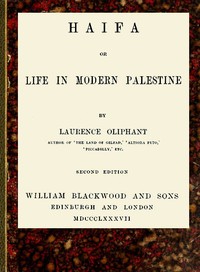
Haifa; or, Life in modern Palestine by Laurence Oliphant
So, what's this book actually about? Laurence Oliphant, a British MP and writer, packs up his life in the 1880s and heads to what was then Ottoman Palestine. He's not there to dig up ruins or write a quick travelogue. He's on a personal mission. He believes in creating a safe haven for Jewish settlers through agricultural communities, and he picks Haifa as his base.
The Story
The 'plot' is the story of his daily life. There's no villain in a black cloak. Instead, the conflict is cultural and logistical. We follow Oliphant as he tries to buy land, build a house (a process fraught with delays and misunderstandings), and interact with everyone from Ottoman governors and Bedouin sheikhs to his new Jewish and Arab neighbors. He describes everything: the stunning landscapes, the bustling markets, the strange (to him) foods, and the intricate social codes. The book is built from these small moments—a tense negotiation, a surprising act of kindness, a moment of sheer natural beauty. It's the chronicle of an outsider trying to become an insider, with all the missteps and small victories that come with it.
Why You Should Read It
Here's the thing: Oliphant is a fascinating, flawed guide. He's a man of his time, with all the colonial attitudes you might expect, but he's also genuinely curious and often humble in the face of a culture he doesn't fully grasp. His observations are sharp and vivid. You can feel the heat, smell the spices, and sense his growing affection for the place. Reading this isn't about agreeing with his politics; it's about getting a raw, unfiltered snapshot of a world that's gone. He captures the sounds and rhythms of Haifa before it became the modern city it is today. It makes history feel immediate and human, not like a list of dates and battles.
Final Verdict
This book is perfect for anyone who loves immersive travel writing or personal diaries from history. If you enjoy books that let you time-travel to a specific place and moment, you'll be hooked. It's also great for readers interested in the complex history of Israel/Palestine, offering a ground-level view from a unique and pivotal period. Just be ready to meet a narrator who is both admirable and occasionally frustrating—which, frankly, makes him all the more real. It's a unique and compelling window into a forgotten chapter of daily life.
This content is free to share and distribute. You do not need permission to reproduce this work.
Margaret Ramirez
4 months agoI started reading out of curiosity and the content flows smoothly from one chapter to the next. Definitely a 5-star read.
Ava Sanchez
1 year agoHaving read this twice, the flow of the text seems very fluid. I couldn't put it down.

Michael Wright
1 year agoComprehensive and well-researched.