
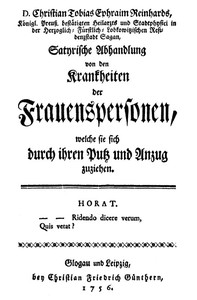
Satyrische Abhandlung von den Krankheiten der Frauenspersonen, welche sie sich…
Let's set the scene: Germany, the mid-1700s. Medicine is a mix of emerging science and very old, very wrong ideas. Into this world comes Christian Tobias Ephraim Reinhard with a book that has a long, clinical-sounding title: Satyrische Abhandlung von den Krankheiten der Frauenspersonen... (A Satirical Treatise on the Diseases of Women...).
The Story
There isn't a plot in the traditional sense. Instead, the 'story' is the argument Reinhard builds. He takes a tour of various ailments—both physical and what we'd call psychological—that were commonly attributed to women at the time. We're talking about everything from fainting spells and nervousness to more specific complaints. His method is to list these 'diseases' and then, under the banner of satire, trace their root cause not to physiology or environment, but to the inherent character of women. He uses exaggerated logic and mocking tones to suggest that female weakness, vanity, and emotionality are the real sicknesses. The entire text is a performance, using the format of a learned dissertation to launch a broadside against half the human population.
Why You Should Read It
This isn't a fun read, but it's a powerful one. Reading it feels like holding a historical artifact of misogyny. It's infuriating, yes, but also fascinating as a case study in how prejudice can dress itself up in academic language. You're not reading it for medical advice or for a good story; you're reading it to understand a mindset. It shows us how 'science' and 'reason' were weaponized to enforce social norms. The most insightful part is the title itself: by calling it a 'satirical treatise,' Reinhard gave himself cover. He could always claim he was just joking or critiquing other doctors, even while his words reinforced harmful stereotypes. It’s a masterclass in passive-aggressive scholarship.
Final Verdict
This book is not for everyone. It's definitely not for someone looking for a light or enjoyable narrative. However, it's perfect for readers interested in the history of medicine, gender studies, or the history of ideas. If you've ever wondered how archaic and damaging beliefs about women were codified and circulated, this text is a primary source example. It's also valuable for writers or critics interested in the mechanics of satire and rhetoric—how an argument can be constructed to belittle and undermine. Approach it as a historical document, not as a book to be 'liked,' and you'll find it leaves a lasting impression.
You are viewing a work that belongs to the global public domain. Access is open to everyone around the world.
Emily Taylor
1 month agoCitation worthy content.
Joshua Miller
1 year agoGreat reference material for my coursework.
Aiden Scott
7 months agoGreat reference material for my coursework.
Logan Gonzalez
1 year agoMy professor recommended this, and I see why.







Ashley Brown
1 year agoGreat reference material for my coursework.