About 1,552 minutes
The 1995 CIA World Factbook — Inside the Classic
Government
356,929 recorded words. 102 minutes difference from this book's estimate.
View Gutenberg source #571
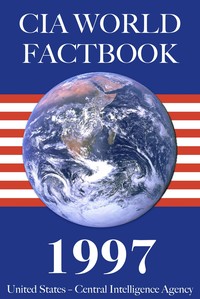
The source record for The 1997 CIA World Factbook — Reading Notes measures this digital text at 380,270 words, 27 hr 34 min estimated reading time, and 56 detected text sections.
The text analysis averages about 20.3 words per sentence, while the detected sections provide another way to judge how the source is divided.
Project Gutenberg metadata also associates the work with “World politics -- Handbooks, manuals, etc.,” connecting these edition facts with the source record’s subject description.
Explore this collection
These alternatives are selected using recorded categories and estimated reading time.
About 1,552 minutes
Government
356,929 recorded words. 102 minutes difference from this book's estimate.
View Gutenberg source #571About 1,457 minutes
Government
335,030 recorded words. 197 minutes difference from this book's estimate.
View Gutenberg source #180About 1,385 minutes
Government
318,387 recorded words. 269 minutes difference from this book's estimate.
View Gutenberg source #42315Search stored excerpts and compare books → Choose by your preferences →
Choices use stored catalog measurements. Estimates vary with reading speed. A shared category is a catalog label, not a claim that two books have the same argument or literary quality.
Search reads excerpt text stored with this catalog and links to its associated Gutenberg record. The connection is stored in the site database; this tool does not recheck that every excerpt is word-for-word identical to that external record. Excerpt search does not cover every chapter and does not verify historical publication dates.
Catalog snapshot checked: 2026-09-26. Coverage: 99 public books, 99 available source excerpts.
Calculated from edition completeness, EPUB availability, text structure and catalogue metadata. Not a user rating.
Total of 100 points, scaled to a 2.5-5.0 range. Editions with an empty description or a missing EPUB file are not scored.
Public-domain source text
The source text is kept in the dedicated reader, separate from this catalogue record and its commentary.
The 1997 CIA World Factbook opens each country entry with a stark, formulaic sentence: for South Korea, the first line reads simply "Tae-chung (DP) 33.8%, CHONG Chu-yong (UPP) 16.3%, other 8%." This abrupt plunge into election percentages, without preamble, typifies the Factbook's approach—it assumes the reader needs no orientation, only data. The prose is relentlessly compressed: abbreviations like "NKP" and "NCNP" appear without expansion, and the voice is that of an institutional observer recording facts without commentary. Yet within this dry framework, the text occasionally reveals unexpected judgments, as when it describes South Korea's economic growth as "an incredible record" and its labor effort as "seldom matched anywhere even in wartime." These evaluative phrases, rare but telling, hint at the human story behind the statistics.
The Factbook's syntax is dominated by lists and parenthetical asides. Political parties are introduced with a colon and then enumerated: "majority party: New Korea Party (NKP), KIM Yong-sam, president." This pattern recurs across every entry, creating a rhythm of classification. The text rarely uses full sentences; instead, it relies on a telegraphic style that prioritizes information density. For example, the legislative branch is described as "unicameral National Assembly or Kukhoe (299 seats; members elected by popular vote to serve four-year terms)." The semicolon separates the institution from its mechanics, and the entire description fits in a single line. This grammar of enumeration allows the Factbook to pack vast amounts of data into a small space, but it also imposes a worldview: every country is reduced to a set of comparable categories.
Despite its reputation for neutrality, the Factbook occasionally slips into subjective language. The South Korea entry describes the country as "one of the Four Dragons of East Asia" and notes its "incredible record of growth." The phrase "unique system of guidance by an authoritarian government" carries a tone of analytical approval, and the claim that the labor force worked "seldom matched anywhere even in wartime" is a striking comparison. These moments are rare but significant—they reveal the CIA's perspective on economic development as a success story. The text also uses hedging: "Growth rates will probably slow down over the medium term." This cautious prediction, embedded in a section otherwise filled with hard numbers, shows the Factbook's willingness to venture into interpretation when the data is uncertain.
Each entry follows a rigid structure: Introduction, Geography, People, Government, Economy, Communications, Transportation, Military, and Transnational Issues. This architecture ensures consistency but also shapes how readers understand a nation. For South Korea, the Government section lists political parties, election results, and diplomatic representation in a flat, unprioritized sequence. The Economy section, by contrast, begins with a narrative overview before diving into GDP figures. This structural choice elevates economic data to a privileged position—it is the only section that allows a paragraph of analysis before the numbers. The Factbook's organization thus subtly prioritizes economic and political information over cultural or historical context, reflecting its intelligence-gathering purpose.
The Factbook is dense with acronyms and initialisms: NKP, NCNP, ULD, DP, AfDB, APEC, AsDB, BIS, CCC, CP, EBRD, ESCAP, FAO, G-77, IAEA, IBRD, ICAO, ICC, ICFTU, ICRM, IDA, IFAD, IFC, IFRCS, IHO, ILO, IMF, IMO, Inmarsat, Intelsat, Interpol, IOC, IOM, ISO, ITU, MINURSO, OAS, OECD, OSCE, UN, UNAVEM III, UNCTAD, UNESCO, UNIDO, UNMOGIP, UNOMIG, UNU, UPU, WHO, WIPO, WMO, WToO, WTrO. This barrage of abbreviations creates a specialized lexicon that excludes the casual reader. The text never defines these terms; it assumes the audience is familiar with international organizations. This stylistic choice reinforces the Factbook's identity as a reference for diplomats and analysts, not the general public. The abbreviations also compress information, allowing the entry to list dozens of memberships in a single line.
Readers approaching the 1997 CIA World Factbook should expect a text that is both exhaustive and elliptical. Its value lies not in narrative flow but in the density of its data and the subtle biases embedded in its structure. Pay attention to what the Factbook chooses to emphasize—economic growth rates, political party acronyms, military expenditures—and what it omits, such as cultural life or environmental conditions. The Factbook is a document of its time, reflecting the Cold War's aftermath and the rise of globalization. Use it as a primary source for understanding how U.S. intelligence agencies framed the world in the late 1990s.
I found myself lingering over the 1997 CIA World Factbook’s dry, precise passages, a pleasure in their own quiet rigor. That same afternoon, I recalled another kind of official voice, a softer, more insidious hum of administration, prompting a memory of the Secret history of the English occupation of Egypt — Story, Setting & Ideas. Bureaucracy, it seems, has its own secret poetry, one buried in ledgers and directives.
Build a private reading journal entry for this title.