About 498 minutes
Memoirs of the Life of the Rt. Hon. Richard Brinsley Sheridan — Volume 01 — Background and Themes
Government
114,497 recorded words. 5 minutes difference from this book's estimate.
View Gutenberg source #6741
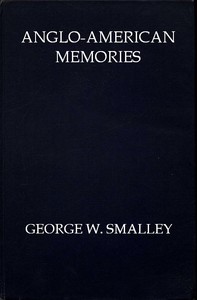
The source record for Anglo-American Memories — Background and Themes measures this digital text at 113,308 words, 8 hr 13 min estimated reading time, and 11 detected text sections.
The text analysis averages about 18.0 words per sentence, while the detected sections provide another way to judge how the source is divided.
Project Gutenberg metadata also associates the work with “United States -- Politics and government,” connecting these edition facts with the source record’s subject description.
Explore this collection
These alternatives are selected using recorded categories and estimated reading time.
About 498 minutes
Government
114,497 recorded words. 5 minutes difference from this book's estimate.
View Gutenberg source #6741About 480 minutes
Government
110,266 recorded words. 13 minutes difference from this book's estimate.
View Gutenberg source #34455About 471 minutes
Government
108,175 recorded words. 22 minutes difference from this book's estimate.
View Gutenberg source #11125Search stored excerpts and compare books → Choose by your preferences →
Choices use stored catalog measurements. Estimates vary with reading speed. A shared category is a catalog label, not a claim that two books have the same argument or literary quality.
Search reads excerpt text stored with this catalog and links to its associated Gutenberg record. The connection is stored in the site database; this tool does not recheck that every excerpt is word-for-word identical to that external record. Excerpt search does not cover every chapter and does not verify historical publication dates.
Catalog snapshot checked: 2026-09-26. Coverage: 99 public books, 99 available source excerpts.
Calculated from edition completeness, EPUB availability, text structure and catalogue metadata. Not a user rating.
Total of 100 points, scaled to a 2.5-5.0 range. Editions with an empty description or a missing EPUB file are not scored.
Public-domain source text
The source text is kept in the dedicated reader, separate from this catalogue record and its commentary.
George W. Smalley's Anglo-American Memories (1911) collects his Sunday columns for the New York Tribune, offering a journalist's perspective on transatlantic politics and society from the 1850s onward. The catalog subjects list United States and Great Britain politics, but the excerpts reveal a narrower focus: Smalley's professional relationships with notable figures and his role in war correspondence. The preface states the book is "mainly concerned with men of exceptional mark and position" and makes "no attempt at a consecutive story." This episodic structure shapes the reader's experience, as each chapter stands as a self-contained portrait or incident.
Smalley's memoir is less about himself than about the people he observed, but his choices of subjects and anecdotes reveal his own values and professional identity. In the preface, he notes the book is "in some slight degree, autobiographical, but only so far as necessary to explain my relations with those men and women." The excerpts show him as a confident insider: he describes his method for covering the Franco-Prussian War, sending two correspondents to opposing headquarters, a tactic he claims was "quite novel in England." He also recounts how the Tribune established a London office years before other American papers, positioning himself as an innovator. These details, drawn from his own experience, build a portrait of a shrewd, competitive journalist proud of his paper's independence.
The longest excerpt details the outbreak of the Franco-Prussian War in July 1870, emphasizing the unexpectedness of the conflict and the slow response of British newspapers. Smalley criticizes Fleet Street for ignoring American journalism, noting that "the area of all possible competition in war news was confined, in their view, to Fleet Street and Printing House Square." He contrasts this with the Tribune's approach, which involved cabling dispatches from London. The passage includes a precise timeline of events from July 4 to July 15, showing Smalley's attention to chronology. He also names Lord Northcliffe (then two years old) as a future force in journalism, a retrospective nod that underscores his own foresight. The focus is on the mechanics of news gathering, not on battle tactics.
The catalog lists "United States -- Politics and government" and "Great Britain -- Politics and government," but the excerpts do not provide systematic analysis of either. Instead, Smalley offers personal impressions of political figures like Bismarck, Lord Granville, and Émile Ollivier, often with sharp judgments. He calls Ollivier's account of the war's origins "elaborate special pleading" and blames France's demand for guarantees after Prussia's withdrawal. These are opinions, not balanced histories. The subject "Europe -- Politics and government -- 1871-1918" is barely touched; the war excerpt ends in 1870. Readers expecting a comprehensive political study will find a journalist's selective memoir, rich in anecdote but limited in scope. The book's value lies in its firsthand voice, not its coverage of catalog topics.
Smalley's Anglo-American Memories rewards readers interested in the craft of journalism and the personalities behind nineteenth-century politics. Approach each chapter as a standalone sketch, and note how Smalley's own role—as observer, participant, and competitor—shapes every account. The book is best read for its specific, often opinionated details rather than as a general history.
The rain tapped against the window while Smalley’s recollections of Bismarck’s bluntness lingered in my mind—how diplomacy often hides more than it reveals. That thread pulled me, almost without thinking, toward the quiet persistence of an earlier ambassador’s letters. Lord Lyons: A Record of British Diplomacy, Vol. 1 of 2 — Reading Notes felt like turning from a noisy battlefield to a candlelit desk, where patience mattered more than spectacle.
Answer a few questions and save a private reflection on this device.









