About 173 minutes
The Crisis in Russia — Reading Companion
Government
39,648 recorded words. 7 minutes difference from this book's estimate.
View Gutenberg source #1326
The source record for Anticipation — Themes and Context measures this digital text at 38,174 words, 2 hr 46 min estimated reading time, and 11 detected text sections.
The text analysis averages about 22.1 words per sentence, while the detected sections provide another way to judge how the source is divided.
Project Gutenberg metadata also associates the work with “Satire,” connecting these edition facts with the source record’s subject description.
Explore this collection
These alternatives are selected using recorded categories and estimated reading time.
About 173 minutes
Government
39,648 recorded words. 7 minutes difference from this book's estimate.
View Gutenberg source #1326About 191 minutes
Government
43,759 recorded words. 25 minutes difference from this book's estimate.
View Gutenberg source #15106About 207 minutes
Government
47,501 recorded words. 41 minutes difference from this book's estimate.
View Gutenberg source #20007Search stored excerpts and compare books → Choose by your preferences →
Choices use stored catalog measurements. Estimates vary with reading speed. A shared category is a catalog label, not a claim that two books have the same argument or literary quality.
Search reads excerpt text stored with this catalog and links to its associated Gutenberg record. The connection is stored in the site database; this tool does not recheck that every excerpt is word-for-word identical to that external record. Excerpt search does not cover every chapter and does not verify historical publication dates.
Catalog snapshot checked: 2026-09-26. Coverage: 99 public books, 99 available source excerpts.
Calculated from edition completeness, EPUB availability, text structure and catalogue metadata. Not a user rating.
Total of 100 points, scaled to a 2.5-5.0 range. Editions with an empty description or a missing EPUB file are not scored.
Public-domain source text
The source text is kept in the dedicated reader, separate from this catalogue record and its commentary.
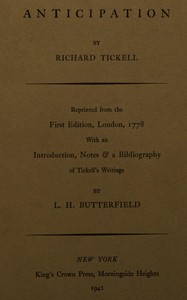
Richard Tickell's Anticipation (1778) is a satirical pamphlet that fabricates a full day's debate in the House of Commons, purporting to report speeches that had not yet been delivered. The work mimics the typography and format of the official Parliamentary Debates, down to the use of dashes and abbreviations (e.g., 'H—s- of C-mm-ns'). Tickell's targets are the rhetorical habits of Lord North's ministry and the opposition during the American War, and his method is to exaggerate their characteristic arguments and mannerisms. The excerpts show a careful attention to the cadence of parliamentary speech—the hedging ('I confess'), the appeals to precedent, and the strategic invocation of past heroes—all deployed to expose the emptiness of the government's case.
Anticipation is structured as a single continuous debate, with speakers identified by abbreviated names (e.g., 'Lord N[o]rth') and their speeches separated by bracketed page numbers that mimic the original pamphlet's pagination. Tickell does not provide stage directions or narrative framing; the reader is dropped directly into the parliamentary chamber. This formal choice forces attention onto the language itself—the repeated phrases, the logical leaps, and the reliance on vague abstractions like 'the importance of that proceeding required the nicest secrecy.' The absence of authorial commentary means the satire emerges from the gap between the speakers' confident assertions and the reader's knowledge of the war's actual course.
A striking pattern in the excerpts is the pairing of images of national 'ruin' with gestures toward miraculous deliverance. Lord North's speech acknowledges 'aggravated ruin' and 'desperate' circumstances, but immediately pivots to the hope that 'this Country has not been able to extricate itself' when 'rouzed by a sense of its wrongs.' The opposition speaker, meanwhile, dwells on 'the wickedness of Ministers' and the 'bad policy' of negotiations. Both sides invoke the memory of a 'great Character' from the last war—likely William Pitt—as a rhetorical trump card. Tickell lets these images accumulate without resolution, suggesting that the debate itself is a ritual performance rather than a genuine deliberation.
The text's movement is not scenic but rhetorical: each speech responds to the previous one, creating a chain of rebuttals and qualifications. The opposition speaker begins by noting the 'asperity' of his predecessor, then proceeds to 'give some answers to assertions.' Tickell captures the way parliamentary debate proceeds by selective response—ignoring some points while amplifying others. The frequent interruptions by the Speaker ('Mr. Sp[eake]r') and the use of 'Sir' as a pause marker reinforce the sense of a live, unruly exchange. Yet the overall effect is one of circularity: the same arguments about secrecy, negotiation, and the role of France recur across speeches, as if the debate is trapped in its own logic.
Tickell's satire operates not through overt mockery but through hyper-fidelity to the conventions of parliamentary reporting. The text includes the full apparatus of debate—the honorifics, the procedural phrases ('I will add,' 'I am free to confess'), and the careful hedging ('though I do not mean to suggest'). By reproducing these forms without comment, Tickell invites the reader to recognize the gap between the gravity of the occasion and the banality of the arguments. The foreword to this edition notes that a twentieth-century parallel—a German propaganda pamphlet mimicking the Parliamentary Debates—demonstrates the enduring power of this satirical technique. Anticipation thus functions as both a period piece and a model for political parody.
Readers approaching Anticipation should attend to the interplay between the text's surface realism and its underlying absurdity. Tickell's achievement is to make the familiar machinery of parliamentary debate seem strange, even grotesque, by pushing it to its logical extreme. The pamphlet rewards those who read slowly, parsing the rhetorical moves and noting the recurring images of crisis and recovery. It is a work that demands historical knowledge—of the American War, of Lord North's ministry, of the conventions of eighteenth-century political discourse—but it also speaks to any era in which political language becomes a substitute for action.
Reading this satirical parliament, I remembered sitting on a porch in July, the air thick with cicadas, wondering how any account of a council—London or prairie—could claim true record. Each page denies its own certainty. That same unease, that tenderness for flawed attempts at order, came back with Sioux Indian Courts An address delivered by Doane Robinson before the South Dakota Bar Association, at Pierre, South Dakota, January 21, 1909 — Story, Setting & Ideas. Both are ghosts of form, speaking softly about what law leaves unspoken.
Your answers remain private and are stored only in this browser.









