About 173 minutes
The Dock and the Scaffold The Manchester Tragedy and the Cruise of the Jacknell — A Closer Reading
Democracy Rights
39,693 recorded words. 2 minutes difference from this book's estimate.
View Gutenberg source #12961
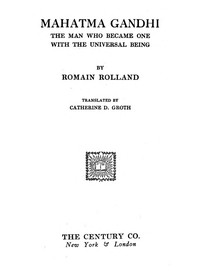
Mahatma Gandhi: The Man Who Became One With the Universal Being — Inside the Classic can be approached with a clearer sense of reading commitment from its source measurements: 40,091 words, 2 hr 55 min estimated reading time, and 5 detected text sections.
The text analysis averages about 17.3 words per sentence, while the detected sections provide another way to judge how the source is divided.
Project Gutenberg metadata also associates the work with “India -- Politics and government -- 1919-1947,” connecting these edition facts with the source record’s subject description.
Explore this collection
These alternatives are selected using recorded categories and estimated reading time.
About 173 minutes
Democracy Rights
39,693 recorded words. 2 minutes difference from this book's estimate.
View Gutenberg source #12961About 189 minutes
Democracy Rights
43,242 recorded words. 14 minutes difference from this book's estimate.
View Gutenberg source #12853About 251 minutes
Democracy Rights
57,707 recorded words. 76 minutes difference from this book's estimate.
View Gutenberg source #71707Search stored excerpts and compare books → Choose by your preferences →
Choices use stored catalog measurements. Estimates vary with reading speed. A shared category is a catalog label, not a claim that two books have the same argument or literary quality.
Search reads excerpt text stored with this catalog and links to its associated Gutenberg record. The connection is stored in the site database; this tool does not recheck that every excerpt is word-for-word identical to that external record. Excerpt search does not cover every chapter and does not verify historical publication dates.
Catalog snapshot checked: 2026-09-26. Coverage: 99 public books, 99 available source excerpts.
Calculated from edition completeness, EPUB availability, text structure and catalogue metadata. Not a user rating.
Total of 100 points, scaled to a 2.5-5.0 range. Editions with an empty description or a missing EPUB file are not scored.
Public-domain source text
The source text is kept in the dedicated reader, separate from this catalogue record and its commentary.
Romain Rolland opens his biographical essay not with a political event but with a physical description: 'Dark, tranquil eyes. A small frail man, a thin face with large protruding ears.' This initial focus on Gandhi's appearance—barefoot, in coarse white cloth, sleeping on the floor—establishes a pattern of grounding abstract ideas in concrete details. Rolland repeatedly returns to the body as a site of meaning, noting that Gandhi's 'body does not seem to count at all' even as it becomes the instrument of his influence. The essay's structure mirrors this movement between the intimate and the vast, shifting from personal encounters to the 'tumultuous year' of Indian politics.
Rolland builds his case through layered description. He cites W. W. Pearson's instinctive comparison to St. Francis of Assisi, then immediately qualifies it: Gandhi is 'modest and unassuming, to the point of sometimes seeming almost timid, hesitant, in making an assertion.' Yet this hesitancy coexists with an 'indomitable spirit.' The essay's opening pages weave together external observations—Pearson's, Tagore's quoted stanza from the Upanishads—with Rolland's own interpretive voice. He presents Gandhi as a man who 'shrinks unconsciously from the great popular demonstrations organized in his honor,' literally 'ill with the multitude that adores him.' This tension between the private ascetic and the public leader becomes the essay's central dynamic.
Rolland frequently employs maritime imagery to describe Gandhi's political role. He speaks of 'the pilot's hand' steering 'the colossal ship along the chosen course' through 'the maze of events.' The metaphor recurs when he describes the difficulty of directing a movement that 'by the slightest ripple, affected hundreds of millions of men.' The pilot 'prays and relies on God; but the voice that comes to him is almost lost in the roar of the tempest.' This language emphasizes both Gandhi's agency and the overwhelming forces he navigates. Rolland does not resolve the tension; instead, he presents it as a 'superhuman problem' of reconciling 'moderation and high-mindedness with surging, unbridled mob passions.'
Rolland incorporates extended quotations from Gandhi, allowing him to speak in his own terms. Gandhi rejects the label of saint: 'The word "saint," he says, should be ruled out of present life.' He insists on his ordinariness: 'I pray like every good Hindu. I believe we can all be messengers of God. I have no special revelations.' Yet Rolland immediately undercuts this humility by noting that 'his very attitude proves that he is one.' The essay also includes Gandhi's definition of patriotism as 'the same as humanity'—a claim that Rolland tests by asking what happens when disciples interpret the doctrine. This interplay between Gandhi's self-presentation and Rolland's framing creates a layered portrait.
Late in the excerpts, Rolland introduces a controversy with Rabindranath Tagore. Tagore, returning from Europe in August 1921, was 'astounded at the change in the mentality of the people' and had expressed anxiety in letters published in the Modern Review. Rolland presents this as a clash between 'two great minds, both moved by mutual admiration and esteem, but as fatally separated.' The controversy serves as a structural pivot, moving the essay from biography to intellectual history. It also raises the question of how Gandhi's message is transformed by his followers—a concern that echoes Rolland's earlier worry about 'mobocracy' and the difficulty of maintaining control over a mass movement.
Rolland's essay resists hagiography by foregrounding the gaps between Gandhi's self-conception and his public role. Readers should attend to the recurring images of navigation and the body, and to the way Rolland juxtaposes intimate detail with sweeping historical claim. The excerpts leave the Tagore controversy unresolved, suggesting that the full work may explore how Gandhi's ideas fared beyond his immediate control.
Rain drummed on the window while I finished Romain Rolland’s portrait of Gandhi—that frail man who moved millions without ever leaving his own stillness. Afterwards, the silence felt heavier, almost demanding company. I found myself reaching for another voice from that same restless century, someone who also wrestled with conviction and consequence. The Life Story of an Old Rebel — Context and Discussion sat waiting, its title like a quiet echo of everything I’d just put down.
Save your reaction, strongest insight, and memorable passage.