About 305 minutes
Is Ulster Right? — Text and Context
Democracy Rights
69,963 recorded words. 54 minutes difference from this book's estimate.
View Gutenberg source #13157
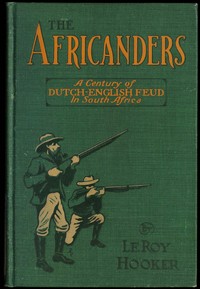
The source record for The Africanders — Key Ideas to Explore measures this digital text at 57,707 words, 4 hr 11 min estimated reading time, and 19 detected text sections.
The text analysis averages about 24.7 words per sentence, while the detected sections provide another way to judge how the source is divided.
Project Gutenberg metadata also associates the work with “Transvaal (South Africa) -- History,” connecting these edition facts with the source record’s subject description.
Explore this collection
These alternatives are selected using recorded categories and estimated reading time.
About 305 minutes
Democracy Rights
69,963 recorded words. 54 minutes difference from this book's estimate.
View Gutenberg source #13157About 189 minutes
Democracy Rights
43,242 recorded words. 62 minutes difference from this book's estimate.
View Gutenberg source #12853About 175 minutes
Democracy Rights
40,091 recorded words. 76 minutes difference from this book's estimate.
View Gutenberg source #61575Search stored excerpts and compare books → Choose by your preferences →
Choices use stored catalog measurements. Estimates vary with reading speed. A shared category is a catalog label, not a claim that two books have the same argument or literary quality.
Search reads excerpt text stored with this catalog and links to its associated Gutenberg record. The connection is stored in the site database; this tool does not recheck that every excerpt is word-for-word identical to that external record. Excerpt search does not cover every chapter and does not verify historical publication dates.
Catalog snapshot checked: 2026-09-26. Coverage: 99 public books, 99 available source excerpts.
Calculated from edition completeness, EPUB availability, text structure and catalogue metadata. Not a user rating.
Total of 100 points, scaled to a 2.5-5.0 range. Editions with an empty description or a missing EPUB file are not scored.
Public-domain source text
The source text is kept in the dedicated reader, separate from this catalogue record and its commentary.
Le Roy Hooker opens his 1900 history with a striking declaration of ancestry: he is of 'purely Anglo-Saxon progenitors with no admixture of any other blood,' yet he aims to present a 'plain, unvarnished tale' of the Dutch-English feud in South Africa. This tension between claimed impartiality and acknowledged heritage sets the tone for a narrative that traces conflict from the Dutch arrival at the Cape in 1652 through the outbreak of the Second Boer War in 1899.
The book's structure is episodic, built around a series of 'contacts' between Africander and Briton—diplomatic, military, and political—each chapter marking a new phase of struggle. Hooker's language is often blunt: he describes 'unspeakable atrocities' committed by both sides in native wars, and he does not shy from criticizing British policy or Africander governance.
The table of contents reveals a deliberate architecture: the first three chapters cover the Dutch at the Cape and the first contact with Britain in 1795, both in diplomacy and war. Subsequent chapters trace the 'First Trek to the North' (1806–1838), then the 'Second Contact' in Natal and north of the Orange River, followed by the 'Second Trek.' The narrative then examines slavery, the third contact in the Orange Free State and Transvaal, and culminates in the 'First War of Independence' and a lengthy analysis of the causes of the second war, spread across four chapters.
This structure emphasizes a recurring pattern: each period of conflict is followed by a trek or a war of independence, suggesting a cyclical view of history. Hooker's chapter titles themselves—'First Contact,' 'Second Contact,' 'Third Contact'—imply a serial escalation, with each encounter building toward the final rupture. The final chapter, 'The Country of the Africanders,' shifts to geography and resources, perhaps grounding the political narrative in material conditions.
One of the most detailed passages in the excerpts describes the Transvaal Republic in the early 1860s, after a period of civil strife. Hooker writes that 'the injury it had inflicted was well nigh incurable,' listing a depleted treasury, uncollected taxes, and salaries in arrears. The republic had 'forfeited the confidence of other nations,' and even the Orange Free State 'no longer desired union.' The white population was under 30,000, while 'the blacks in the same territory numbered hundreds of thousands.'
Hooker's account of the Zulu chief Cetawayo is particularly vivid: he is described as 'a chief of remarkable subtlety and power,' who repudiated a boundary agreement and 'removed the landmarks so lately set up.' The narrative then details 'perpetual struggle with the blacks,' with 'unspeakable atrocities' on both sides. Hooker notes that the whites could defeat natives in battle but could not hold them in subjection, and that the Africanders 'had an invincible dislike to paying taxes.' This passage reveals Hooker's willingness to criticize both British and Africander actions, while also reflecting contemporary racial attitudes.
Hooker's foreword is a rare moment of self-disclosure: he acknowledges that his Anglo-Saxon ancestry might have 'predisposed me to magnify everything' that exemplified British prowess, but he claims to have resisted this. The phrase 'plain, unvarnished tale' echoes Shakespeare's Othello, suggesting a desire for credibility. Yet the narrative is not neutral: Hooker uses the term 'Africanders' throughout, a choice that aligns with Boer self-identification, and he frames the wars as 'wars of independence,' a term that implies legitimacy for the Boer cause.
The prose is direct and often judgmental. Hooker describes the Transvaal government as 'tottering' and 'inefficient,' and he notes that the British intervention was seen by some as 'necessary and justifiable.' He does not hide his opinions, but he also includes details that complicate a simple pro-British or pro-Boer reading. The result is a history that is both partisan and informative, reflecting the tensions of its time.
Readers should approach The Africanders as a document of its era—a history written during the Second Boer War by an American author with declared Anglo-Saxon heritage but a professed aim of fairness. Hooker's narrative is rich in political and military detail, but his perspective is shaped by late-nineteenth-century assumptions about race, governance, and national destiny. The book is most valuable when read alongside other contemporary accounts, allowing the reader to weigh Hooker's claims against alternative sources.
There’s something haunting about Hooker’s certainty in The Africanders, that old Anglo-Saxon confidence in the rightness of empire. It makes you wonder what he’d make of the discontent brewing elsewhere. I keep thinking of Indian Unrest — A Closer Reading beside it, two empires straining at their own seams, both histories whispering the same quiet warning about power that doesn’t listen.
Your answers remain private and are stored only in this browser.