About 672 minutes
The Life of Bismarck, Private and Political With Descriptive Notices of His Ancestry — Reading Notes
Government
154,488 recorded words. 1 minutes difference from this book's estimate.
View Gutenberg source #58776
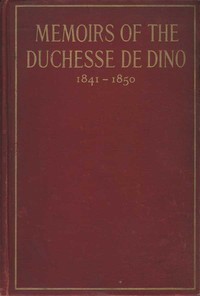
Before opening Memoirs of the Duchesse De Dino (Afterwards Duchesse de Talleyrand et de Sagan), 1841-1850 — Context and Discussion, the edition data offers a quick orientation: 154,593 words, 11 hr 13 min estimated reading time, and 24 detected text sections.
The text analysis averages about 18.2 words per sentence, while the detected sections provide another way to judge how the source is divided.
Project Gutenberg metadata also associates the work with “Dino, Dorothée, duchesse de, 1793-1862,” connecting these edition facts with the source record’s subject description.
Explore this collection
These alternatives are selected using recorded categories and estimated reading time.
About 672 minutes
Government
154,488 recorded words. 1 minutes difference from this book's estimate.
View Gutenberg source #58776About 670 minutes
Government
154,090 recorded words. 3 minutes difference from this book's estimate.
View Gutenberg source #2581About 651 minutes
Government
149,513 recorded words. 22 minutes difference from this book's estimate.
View Gutenberg source #37890Search stored excerpts and compare books → Choose by your preferences →
Choices use stored catalog measurements. Estimates vary with reading speed. A shared category is a catalog label, not a claim that two books have the same argument or literary quality.
Search reads excerpt text stored with this catalog and links to its associated Gutenberg record. The connection is stored in the site database; this tool does not recheck that every excerpt is word-for-word identical to that external record. Excerpt search does not cover every chapter and does not verify historical publication dates.
Catalog snapshot checked: 2026-09-26. Coverage: 99 public books, 99 available source excerpts.
Calculated from edition completeness, EPUB availability, text structure and catalogue metadata. Not a user rating.
Total of 100 points, scaled to a 2.5-5.0 range. Editions with an empty description or a missing EPUB file are not scored.
Public-domain source text
The source text is kept in the dedicated reader, separate from this catalogue record and its commentary.
Dorothée de Dino’s journal entries from 1841 to 1850 offer a firsthand view of European high politics and society through the eyes of a woman who moved among kings, ministers, and intellectuals. Writing from châteaux, capital cities, and spas, she records not only diplomatic shifts—such as the fortifications of Paris, Spanish affairs, and the revolutions of 1848—but also the texture of daily life: a concert at Sans Souci, a quadrille at Nice, the quiet decay of Sagan’s charitable foundations. Her voice is precise, often wry, and attentive to both public ceremony and private friendship.
The Duchess’s entries move rapidly between locations—Rochecotte, Berlin, Vienna, Sagan—and her observations shift accordingly. In Berlin she notes the staging of A Midsummer Night’s Dream translated by Schlegel and a private concert with Madame Viardot Garcia, whom she finds “very attractive in spite of her plainness.” At Vienna she contrasts the quieter social rhythm: the theatre ends by half-past nine, and Prince Metternich’s parties draw only five or six regular visitors. These details are not mere travelogue; they reveal how the Duchess calibrates her tone to each court, measuring formality, intimacy, and political undercurrents through the lens of entertainment and hospitality.
At Sagan, the Duchess inspects a town of seven thousand people with six churches, five Catholic, and charitable foundations “some six hundred years old.” She reflects that these works endure while “purely secular monuments so rapidly decay.” The passage intertwines her role as landowner with a broader meditation on legacy. Earlier, she informs the King of Prussia that a treaty with her nephew has been concluded, and notes the King’s “kindness” in abandoning prejudices toward her family. These moments show her managing estates, titles, and family alliances—work that is both personal and political, and that she records with a mixture of satisfaction and weariness.
Amid diplomatic reports, the Duchess dwells on loss. She writes of the Duchesse Mathieu de Montmorency’s bronchitis, calling her and Mgr. de Quélen “friends not merely for time but for eternity.” A letter from M. Royer-Collard, with its altered handwriting, prompts her to feel that “my happiness is threatened in the person of my best friends.” Since Talleyrand’s death, she says, she has been “terribly tried” in this respect. These passages ground the memoir in a personal register: the same woman who analyzes court factions also mourns the fragility of those she loves, and her faith provides a steady counterpoint to political instability.
Readers should approach these memoirs as a layered document: part private diary, part political report, part spiritual reflection. The Duchess rarely explains context; she assumes her reader knows the players and events. To follow her, keep a map of Europe and a list of names at hand. The reward is an intimate, unsentimental portrait of a woman who held her own among the powerful, and who wrote not for posterity but to fix her own impressions while they were still sharp.
There's something about Dorothée’s journal that stays with you—that quiet watching of courts and characters. I felt that same lingering patience reading Lord Lyons: A Record of British Diplomacy, Vol. 1 of 2 — Reading Notes. Not the action, but the steady, observant eye behind it. A kind of tender, almost solitary company.
Save your reaction, strongest insight, and memorable passage.









