About 260 minutes
Second Treatise of Government — Reading Companion
Political Thought
59,745 recorded words. 2 minutes difference from this book's estimate.
View Gutenberg source #7370
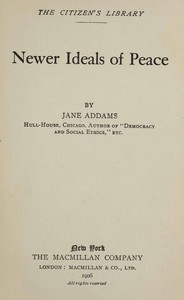
The source record for Newer ideals of peace — Inside the Classic measures this digital text at 59,141 words, 4 hr 18 min estimated reading time, and 16 detected text sections.
The text analysis averages about 33.1 words per sentence, while the detected sections provide another way to judge how the source is divided.
Project Gutenberg metadata also associates the work with “Peace,” connecting these edition facts with the source record’s subject description.
Explore this collection
These alternatives are selected using recorded categories and estimated reading time.
About 260 minutes
Political Thought
59,745 recorded words. 2 minutes difference from this book's estimate.
View Gutenberg source #7370About 262 minutes
Political Thought
60,187 recorded words. 4 minutes difference from this book's estimate.
View Gutenberg source #4350About 231 minutes
Political Thought
53,106 recorded words. 27 minutes difference from this book's estimate.
View Gutenberg source #39568Search stored excerpts and compare books → Choose by your preferences →
Choices use stored catalog measurements. Estimates vary with reading speed. A shared category is a catalog label, not a claim that two books have the same argument or literary quality.
Search reads excerpt text stored with this catalog and links to its associated Gutenberg record. The connection is stored in the site database; this tool does not recheck that every excerpt is word-for-word identical to that external record. Excerpt search does not cover every chapter and does not verify historical publication dates.
Catalog snapshot checked: 2026-09-26. Coverage: 99 public books, 99 available source excerpts.
Calculated from edition completeness, EPUB availability, text structure and catalogue metadata. Not a user rating.
Total of 100 points, scaled to a 2.5-5.0 range. Editions with an empty description or a missing EPUB file are not scored.
Public-domain source text
The source text is kept in the dedicated reader, separate from this catalogue record and its commentary.
Jane Addams opens Newer Ideals of Peace by situating her study in the industrial quarter of a cosmopolitan city, where morality exhibits marked social and international aspects. The book does not argue for peace as a static absence of war but as a dynamic force that, if made operative, will do away with war as a natural process. Addams draws on her experience at Hull-House to ground her analysis in concrete urban conditions rather than abstract theory.
The excerpts focus heavily on Chicago's trade unions, particularly the phenomenon of newly organized unions—what Addams calls baby unions. She observes that strikes characterized by disorder and police interference almost universally involve these young unions. The Chicago Federation of Labor often endorses hot-headed strikes because delegates from newly organized unions hold the larger vote, overriding the judgment of older unions. Addams notes that the labor movement attracts organizations exhibiting the weakness of group morality, a primitive stage akin to early patriotism where loyalty is intense but exclusive. The language of war pervades this stage, with pickets and battle-grounds common. A proposal to require a two-year waiting period before a union could authorize a strike failed because organizers believed it would cripple recruitment. This concrete example illustrates how the drive for solidarity can undermine long-term strategic interests.
Addams repeatedly shows how the vocabulary of conflict infiltrates movements ostensibly seeking justice. The newly organized unions respond to appeals to strike because such appeals stir memories of their organization night, when they were admitted after solemn ceremonies into the American Federation of Labor. Organizers often make overly large promises about what organization will accomplish, citing other unions' successes without mentioning their long history of steady dues payment. The result is a strike fever in which accumulated grievances and a desire to fight for their rights override calculated judgment. Addams does not condemn this impulse but diagnoses it as a transitional phase, analogous to the rough rider versus the disciplined soldier. The excerpts suggest that peace, for Addams, requires not the elimination of conflict but its channeling into more mature, inclusive forms of social organization.
Although the excerpts do not fully develop this argument, the book's catalog subjects—municipal government, social justice, political participation—indicate that Addams sees local governance as a key arena for developing moral substitutes for war. The prefatory note states that the studies were made in the industrial quarter of a cosmopolitan city, implying that urban diversity itself fosters international and social morality. Addams's earlier work Democracy and Social Ethics is listed in the same series, suggesting continuity. The excerpts on labor unions show her method: examining concrete cases to extract broader principles. Readers should expect a pragmatic, reformist argument that ties peace to everyday democratic practice rather than to treaties or arbitration. The book likely contends that genuine peace emerges from the messy, conflict-ridden process of building inclusive institutions.
Addams's evidence is drawn from her immediate surroundings, not from diplomatic history. Readers will find a social worker's perspective that treats peace as an evolving social achievement rather than a fixed ideal. The book rewards attention to its specific examples—Chicago strikes, union dynamics, municipal experiments—as the foundation for its broader claims.
That gray afternoon, Jane Addams’s Newer Ideals of Peace left me with her strange comfort—that conflict, properly channeled through civic life, might soften into something akin to neighborliness. I closed it, and my hand wandered to another shelf, pulling down Our Changing Constitution — Reading Notes. It felt like a quieter echo of her question, though framed in dry legal terms. Yesterday’s rain held both worlds together, gently.
Build a private reading journal entry for this title.