
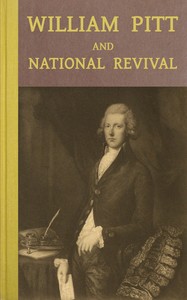
William Pitt and national revival — Inside the Classic

(0 User reviews)   324
In Category - Government
Rose, J. Holland (John Holland), 1855-1942, Gainsborough, Thomas, 1727-1788 [Artist] Project Gutenberg 2024 Not confirmed
Great Britain -- Politics and government -- 1760-1820; Great Britain -- History -- George III, 1760-1820; Pitt, William, 1759-1806 Readers of public-domain and historical texts
Project Gutenberg digital edition en

Edition facts

Words 266,406
Reading time 1159 min
Text sections 59

The catalog record for William Pitt and national revival — Inside the Classic provides practical reading context through 266,406 words, 19 hr 19 min estimated reading time, and 59 detected text sections.

The text analysis averages about 21.8 words per sentence, while the detected sections provide another way to judge how the source is divided.

Project Gutenberg metadata also associates the work with “Great Britain -- Politics and government -- 1760-1820,” connecting these edition facts with the source record’s subject description.

Explore this collection

Compare your next read

These alternatives are selected using recorded categories and estimated reading time.

Search stored excerpts and compare books → Choose by your preferences →

How these choices and excerpts are prepared

Choices use stored catalog measurements. Estimates vary with reading speed. A shared category is a catalog label, not a claim that two books have the same argument or literary quality.

Search reads excerpt text stored with this catalog and links to its associated Gutenberg record. The connection is stored in the site database; this tool does not recheck that every excerpt is word-for-word identical to that external record. Excerpt search does not cover every chapter and does not verify historical publication dates.

Catalog snapshot checked: 2026-09-26. Coverage: 99 public books, 99 available source excerpts.

J. Holland Rose's 1911 study examines William Pitt the Younger's domestic and foreign policies from 1783 to the French Revolutionary Wars, drawing on newly available archives including the Pitt Manuscripts. The narrative focuses on Pitt's cautious diplomacy, strained cabinet relations, and the interplay between royal influence and ministerial strategy.
Share
Editorial Edition Score 4.9/5

Calculated from edition completeness, EPUB availability, text structure and catalogue metadata. Not a user rating.

How this score is calculated
  • Description quality20 pts
  • Title & short description10 pts
  • Source metadata20 pts
  • Text length15 pts
  • Chapters / structure15 pts
  • EPUB file integrity20 pts

Total of 100 points, scaled to a 2.5-5.0 range. Editions with an empty description or a missing EPUB file are not scored.

Edition quality

Public-domain source text

Read the source text

The source text is kept in the dedicated reader, separate from this catalogue record and its commentary.

J. Holland Rose's William Pitt and National Revival (1911) opens with a frank acknowledgment of its archival debt: the Pitt Manuscripts, Foreign Office records, and private correspondence from Chevening and Orwell Park had become accessible since the last major biography by Earl Stanhope in 1862. Rose positions his work as a detailed account of Pitt's career up to the friction with Revolutionary France, promising to complete the story in a companion volume. The preface signals a historian's method—weighing new evidence against established narratives—rather than a celebratory portrait.

Archival Foundations and Cautious Claims

Rose's preface is unusually explicit about his sources. He names the Pitt Manuscripts, the records of the Foreign Office, War Office, Admiralty, and Home Office, and unpublished correspondence from the Duke of Portland and the Earl of Harrowby. This transparency is not mere formality: it frames the book as a corrective to earlier works that lacked access to these materials. Yet Rose does not overstate his discoveries. He describes the new documents as yielding “proofs of the influence which Pitt exerted” rather than revolutionary reinterpretations. The tone is measured, the ambition limited to a “detailed description” of a career. Readers should note that Rose's claims are grounded in specific archival citations, not sweeping assertions.

Tensions Within the Cabinet: Pitt and Carmarthen

One of the most revealing excerpts concerns a dispute between Pitt and his Foreign Minister, Lord Carmarthen, in January 1787. Carmarthen had written directly to George III urging a more energetic policy in the Netherlands, bypassing Pitt. The King's retort—refusing to act as the “Draw-can-sir of Europe”—and his preoccupation with the Prince of Wales's extravagance show the constraints on Pitt's foreign policy. Carmarthen's apologetic letter to Pitt, quoted at length, reveals a minister trying to reconcile his own eagerness with Pitt's “more cautious” approach. Rose uses this episode to illustrate the friction between a chief who demanded strict etiquette and a colleague who chafed under it. The excerpt suggests that Rose's narrative will attend to personal dynamics as much as policy debates.

The Dutch Crisis and the Limits of Influence

Rose devotes considerable attention to the struggle for ascendancy in Holland, framing it as a contest that affected “the fate of Britain's Indian Empire no less than her position in Europe.” He cites Pitt's calm directive to Sir James Harris in December 1786: the Orange party should “lie by” and avoid committing England prematurely. This cautious policy is contrasted with the ambitions of French ministers, who had considered sending General de Bouillé to conquer British settlements in India but found “no opportunity for going to war.” Rose's handling of the episode emphasizes the gap between strategic goals and practical constraints. The reader is left to observe how Pitt's restraint—shaped by royal caution, financial limits, and diplomatic calculation—shaped the outcome.

Rose's work rewards readers who attend to the interplay of personality, archive, and policy. The excerpts show a historian willing to let documents speak, even when they reveal ministerial discord or royal petulance. Those approaching the full text should watch for how Rose balances his admiration for Pitt's “national revival” with the evidence of friction and failure. The companion volume, William Pitt and the Great War, promises to extend this scrutiny into the revolutionary period.

There’s something poignant about watching Pitt navigate his cautious cabinets, knowing how much of a man’s inner life stays hidden from state papers. It reminds me of Sheridan’s memoirs, where the brilliance is always trailing a shadow of public exhaustion. I found myself drifting toward that gentler reckoning in the Memoirs of the Life of the Rt. Hon. Richard Brinsley Sheridan — Volume 01 — Background and Themes, as if both men simply wanted quieter rooms than history allowed them.

There are no reviews for this eBook.

0
0 out of 5 (0 User reviews )

Add a Review

Your Rating *
There are no comments for this eBook.

Reader reflection

What did you think of this book?

Answer a few questions and save a private reflection on this device.

Your progress 0 / 10
1

What is your current status with this title?

2

Did this book hold your interest?

3

Would you encourage someone else to read it?

4

Did the language feel accessible?

Related eBooks









