About 26 minutes
M. P.'s in Session: From Mr. Punch's Parliamentary Portrait Gallery — Text and Context
Government
5,925 recorded words. 1 minutes difference from this book's estimate.
View Gutenberg source #29560
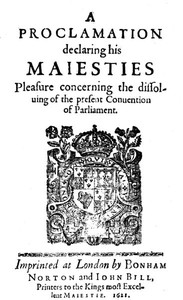
This digital edition of A Proclamation Declaring His Maiesties Pleasure Concerning the Dissoluing of the Present Conuention of Parliament — Inside the Classic is described by source-level measurements including 6,027 words, 27 min estimated reading time, and 1 detected text section.
The text analysis averages about 41.9 words per sentence, while the detected sections provide another way to judge how the source is divided.
Project Gutenberg metadata also associates the work with “Great Britain. Parliament -- Early works to 1800,” connecting these edition facts with the source record’s subject description.
Explore this collection
These alternatives are selected using recorded categories and estimated reading time.
About 26 minutes
Government
5,925 recorded words. 1 minutes difference from this book's estimate.
View Gutenberg source #29560About 34 minutes
Government
7,647 recorded words. 7 minutes difference from this book's estimate.
View Gutenberg source #26021About 49 minutes
Government
11,228 recorded words. 22 minutes difference from this book's estimate.
View Gutenberg source #47413Search stored excerpts and compare books → Choose by your preferences →
Choices use stored catalog measurements. Estimates vary with reading speed. A shared category is a catalog label, not a claim that two books have the same argument or literary quality.
Search reads excerpt text stored with this catalog and links to its associated Gutenberg record. The connection is stored in the site database; this tool does not recheck that every excerpt is word-for-word identical to that external record. Excerpt search does not cover every chapter and does not verify historical publication dates.
Catalog snapshot checked: 2026-09-26. Coverage: 99 public books, 99 available source excerpts.
Calculated from edition completeness, EPUB availability, text structure and catalogue metadata. Not a user rating.
Total of 100 points, scaled to a 2.5-5.0 range. Editions with an empty description or a missing EPUB file are not scored.
Public-domain source text
The source text is kept in the dedicated reader, separate from this catalogue record and its commentary.
The proclamation opens with a striking typographical arrangement: the first lines are set as a stepped block, each phrase on its own line, visually emphasizing the king's assertion that assembling, continuing, and dissolving Parliament is a prerogative "so peculiarly belonging to Our Imperiall Crowne." This visual break immediately signals the document's dual purpose: to declare a decision and to explain it. James I frames the dissolution not as an arbitrary act but as a reasoned response, grounded in "mature deliberation" and the unanimous advice of his Privy Council. The text repeatedly insists on transparency, stating that the king's "continuall custome" is to make subjects acquainted with the reasons behind public actions. Yet this openness is carefully controlled, as the proclamation simultaneously defends royal authority and deflects blame for parliamentary failure.
The proclamation's structure moves from an absolute assertion of royal power to a detailed justification, creating a tension between prerogative and accountability. The opening lines declare that the king "neede not giue account thereof vnto any," yet the very act of issuing the proclamation contradicts this, as James proceeds to explain his reasoning at length. This rhetorical strategy is deliberate: by first establishing that he is not obliged to explain, the king frames his subsequent explanation as a gracious concession rather than a necessity. The text uses the first-person plural throughout, with "We" and "Our" reinforcing the monarch's singular authority even as it claims to speak for the realm. The phrase "with the aduice and vniforme consent of Our whole Priuie Councell" further bolsters the impression of a unified, considered decision, while the repeated references to "mature deliberation" suggest a process of careful thought rather than impulsive action.
Throughout the proclamation, James employs a vocabulary of affection and obligation to characterize the relationship between sovereign and subjects. He speaks of "tokens of loue and duty" that passed between them at the Parliament's beginning, and expresses confidence that, once the true causes are discovered, subjects "wilbe farre from imputing it to any default in Vs." The word "iealousies" appears twice, suggesting that misunderstandings—not genuine conflicts—have disrupted the assembly. This language frames political disagreement as a failure of perception rather than substance. The king also emphasizes his own "Princely care and zeale" for his subjects' welfare, positioning himself as a benevolent figure whose intentions have been misread. The proclamation's closing reiterates this theme, expressing hope for future Parliaments "with confidence of the true and hearty loue and affection of Our subiects."
The document shifts between broad public address and precise legal language, reflecting its dual function as both a royal announcement and a formal instrument. Early passages speak in general terms about the king's intentions and the Parliament's purpose, including the restoration of his children's "ancient and lawfull patrimony" and the settlement of peace and religion. But later sections become more technical, specifying that the adjourned meeting is not to be considered a session, and that those summoned are discharged from attendance. The proclamation concludes with a standard formula—"Giuen at Our Pallace at Westminster"—and the date, grounding the document in time and place. This movement from expansive justification to narrow legal effect mirrors the king's attempt to control both the narrative and the practical consequences of dissolution.
James I's proclamation is acutely aware of its own status as a public text. The opening declares that the king wishes "the World may witnesse with Vs" his intentions, and the document repeatedly addresses itself to "all Our Subiects" and even to "God." This self-consciousness extends to the proclamation's material form: it was printed by Bonham Norton and John Bill, the king's printers, and its typography—with its stepped opening lines—suggests a deliberate effort to create a visually authoritative document. The text also anticipates future interpretation, stating that the dissolved convention "neither is, nor after the ceasing and breaking thereof shall bee, nor ought to bee esteemed, adiudged, or taken to be, or make any Session or Parliament." This triple negation underscores the king's determination to control how the event is understood legally and historically.
Readers approaching this proclamation should attend to its layered rhetoric: it is simultaneously a legal instrument, a political justification, and a piece of royal self-fashioning. The text rewards attention to its vocabulary of emotion and obligation, its careful movement between prerogative and explanation, and its awareness of itself as a document meant to be read and interpreted. The proclamation offers a window into early Stuart political culture, where the language of love and duty could coexist with assertions of absolute power.
That rainy afternoon, I kept returning to how James’s proclamation framed every grievance as a wound to love—duty disguised as misunderstanding, always. It stayed with me, that ache of a ruler explaining himself to people who’d already stopped listening. Later, shelving books, I stumbled onto Perley's reminiscences of sixty years in the national metropolis, v. 1-2 — Text and Context. Different century, same quiet persistence: someone watching power stumble, and writing it down anyway.
Build a private reading journal entry for this title.









