About 56 minutes
A Remonstrance of the State of the Kingdom — Themes and Context
Government
12,799 recorded words. 7 minutes difference from this book's estimate.
View Gutenberg source #63567
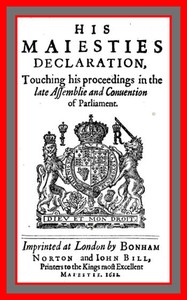
Before opening His Maiesties Declaration, touching his Proceedings in the late Assemblie and Conuention of Parliament — A Closer Reading, the edition data offers a quick orientation: 11,228 words, 49 min estimated reading time, and 2 detected text sections.
The text analysis averages about 46.6 words per sentence, while the detected sections provide another way to judge how the source is divided.
Project Gutenberg metadata also associates the work with “Great Britain -- History -- James I, 1603-1625,” connecting these edition facts with the source record’s subject description.
Explore this collection
These alternatives are selected using recorded categories and estimated reading time.
About 56 minutes
Government
12,799 recorded words. 7 minutes difference from this book's estimate.
View Gutenberg source #63567About 60 minutes
Government
13,681 recorded words. 11 minutes difference from this book's estimate.
View Gutenberg source #70495About 34 minutes
Government
7,647 recorded words. 15 minutes difference from this book's estimate.
View Gutenberg source #26021Search stored excerpts and compare books → Choose by your preferences →
Choices use stored catalog measurements. Estimates vary with reading speed. A shared category is a catalog label, not a claim that two books have the same argument or literary quality.
Search reads excerpt text stored with this catalog and links to its associated Gutenberg record. The connection is stored in the site database; this tool does not recheck that every excerpt is word-for-word identical to that external record. Excerpt search does not cover every chapter and does not verify historical publication dates.
Catalog snapshot checked: 2026-09-26. Coverage: 99 public books, 99 available source excerpts.
Calculated from edition completeness, EPUB availability, text structure and catalogue metadata. Not a user rating.
Total of 100 points, scaled to a 2.5-5.0 range. Editions with an empty description or a missing EPUB file are not scored.
Public-domain source text
The source text is kept in the dedicated reader, separate from this catalogue record and its commentary.
James I's 1621 declaration opens with a striking self-portrait: a monarch who, after dissolving Parliament with the 'vniforme consent' of his Privy Council, nonetheless descends 'many degrees beneath' his station to explain his actions. This framing—powerful king voluntarily unbending—sets the tone for a document that is simultaneously a legal brief, a royal lecture, and a personal grievance. The king insists he is 'Gods true Viceregent' yet spends pages parsing parliamentary precedents and correcting the Commons' Latin. The tension between absolute prerogative and the need to justify it drives every paragraph.
James repeatedly emphasizes that he is going beyond what any prince 'vse to reserue, inter arcana Imperij'—the secrets of empire. He presents his declaration as an act of 'indulgence' and 'fatherly instruction,' mixing the 'peremptorie' force of a proclamation with a milder explanatory mode. This rhetorical posture allows him to assert his absolute authority while appearing gracious. Yet the text reveals a monarch deeply engaged in the very debates he claims to transcend: he quotes the Commons' own language back at them, corrects their misreadings of his letters, and even chides them for misplacing a comma in their logic ('ye erre à bene diuisis ad male coniuncta'). The king cannot resist descending into the arena.
The central conflict turns on the meaning of key terms. James objects to the Commons calling their privileges 'your ancient and vndoubted right and inheritance,' insisting instead that they are 'deriued from the grace and permißion of Our Ancestours and Vs.' He dismisses precedent as mere 'toleration,' not inheritance. Yet he simultaneously promises to preserve their 'lawfull liberties' as carefully as his own prerogative—provided they do not 'trench vpon the Prerogatiue of the Crowne.' The conditional language is precise: privileges are revocable grants, not rights. The king's logic is circular: he will protect liberties only so long as they do not challenge his power, which is precisely when they would need protection.
A substantial portion of the declaration is devoted to correcting what James sees as deliberate misinterpretations of his earlier letters. He accuses the Commons of 'carping wits' who 'peruert and wrest Our words vnto a sence contrary to our meaning.' He painstakingly demonstrates how they have taken sentences 'lying farre asunder' and coupled them together, omitting key phrases like 'mysteries of State.' The king's method is forensic: he quotes his own text, identifies the excision, and supplies the missing context. This attention to textual fidelity reveals a monarch who understands that political authority is exercised through language—and who will not cede control over the interpretation of his own words.
Readers should attend to the layered structure of this declaration: a royal proclamation, a letter to the Commons, and a subsequent explanatory letter, all nested within a single document. James's habit of quoting himself and then glossing his own meaning creates a palimpsest of authority. The text rewards careful parsing of its conditional clauses and legal distinctions. It is less a straightforward account of events than a performance of monarchical reason—one that reveals both the king's intellectual engagement and his profound irritation at being misunderstood.
There’s something achingly familiar in how James I frames his defense—the quiet insistence that a ruler’s burden is misunderstood, that dissent feels like betrayal. It reminded me of another voice, centuries later, wrestling with the same weight of perceived necessity. I keep returning to Virginia's Attitude Toward Slavery and Secession — Background and Themes, where the same painful logic echoes, asking how we ever convinced ourselves otherwise.
Save your reaction, strongest insight, and memorable passage.









