About 56 minutes
A Remonstrance of the State of the Kingdom — Themes and Context
Government
12,799 recorded words. 4 minutes difference from this book's estimate.
View Gutenberg source #63567
Before opening The great inquiry — Inside the Classic, the edition data offers a quick orientation: 13,681 words, 1 hr estimated reading time, and 11 detected text sections.
The text analysis averages about 18.2 words per sentence, while the detected sections provide another way to judge how the source is divided.
Project Gutenberg metadata also associates the work with “Satire,” connecting these edition facts with the source record’s subject description.
Explore this collection
These alternatives are selected using recorded categories and estimated reading time.
About 56 minutes
Government
12,799 recorded words. 4 minutes difference from this book's estimate.
View Gutenberg source #63567About 66 minutes
Government
15,003 recorded words. 6 minutes difference from this book's estimate.
View Gutenberg source #64593About 49 minutes
Government
11,228 recorded words. 11 minutes difference from this book's estimate.
View Gutenberg source #47413Search stored excerpts and compare books → Choose by your preferences →
Choices use stored catalog measurements. Estimates vary with reading speed. A shared category is a catalog label, not a claim that two books have the same argument or literary quality.
Search reads excerpt text stored with this catalog and links to its associated Gutenberg record. The connection is stored in the site database; this tool does not recheck that every excerpt is word-for-word identical to that external record. Excerpt search does not cover every chapter and does not verify historical publication dates.
Catalog snapshot checked: 2026-09-26. Coverage: 99 public books, 99 available source excerpts.
Calculated from edition completeness, EPUB availability, text structure and catalogue metadata. Not a user rating.
Total of 100 points, scaled to a 2.5-5.0 range. Editions with an empty description or a missing EPUB file are not scored.
Public-domain source text
The source text is kept in the dedicated reader, separate from this catalogue record and its commentary.
The Great Inquiry presents itself as the verbatim minutes of a Cabinet committee investigating tariff reform, complete with a mock-official title page, a list of commissioners including Joseph Chamberlain and Arthur Balfour, and a solemn oath 'to bolt out the truth.' Belloc’s satire operates through deadpan bureaucratic language: witnesses are sworn in the 'Scotch manner,' a horse is called to testify on muzzling, and legal objections are dismissed with invented writs like 'de Hæretico Comburendo.' The text originally appeared in the Speaker magazine before being collected into this 'ONLY, FINAL, AND AUTHORISED EDITION.'
The inquiry is conducted by a committee that includes the Lord Privy Seal, the Duke of Marlborough, and 'Mr. Balfour himself.' The proceedings open with a prayer that 'the wisdom of this world might be turned into foolishness.' When only three members arrive, they constitute a quorum. Mr. Chamberlain speaks 'in his legal capacity as member of the Privy Council,' holding a slip of paper, and overrules a challenge from Counsel for the Cobden Club by citing inferior jurisdiction. The Duke of Marlborough, 'in the lowest good humour,' speaks so softly he can hardly be heard. Belloc’s satire targets the pomposity and procedural opacity of Edwardian governance.
The first witness is a horse, sworn by proxy because it is 'evidently impious to swear the animal.' The trainer explains that the horse will prove muzzling has no ill effect. Chamberlain asks if the experiment has been tried on human beings; the trainer answers 'No,' then is corrected to 'No, your worship.' The absurdity escalates when Chamberlain orders, 'Let loose the—' before being interrupted. Belloc mocks the flimsy evidence marshalled for protectionist policies by reducing economic argument to animal trials. The satire relies on the reader’s familiarity with contemporary tariff debates, but the humor works independently through its precise, legalistic absurdity.
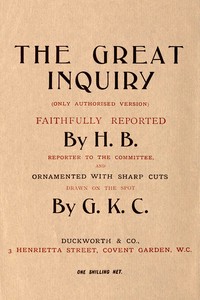
The book is framed as an 'OFFICIAL RECORD' with 'Sharp Cuts Drawn on the Spot' by G. K. Chesterton. The title page boasts it is the 'ONLY, FINAL, AND AUTHORISED EDITION.' Belloc’s preface notes that the minutes were 'officially communicated, as they appeared, to the Speaker.' This mock-serious packaging satirizes the genre of parliamentary blue books and official reports. Chesterton’s illustrations—though not reproduced in the excerpts—are described as 'sharp cuts,' implying a caricaturist’s edge. The collaboration between Belloc and Chesterton, both noted polemicists, amplifies the work’s partisan edge, though the excerpts do not reveal the full range of the illustrations.
Readers unfamiliar with Joseph Chamberlain’s tariff reform campaign or the Cobden Club’s free-trade advocacy will still enjoy the farce of a committee that calls a horse as an expert witness. The satire rewards attention to legal jargon and procedural detail, which Belloc deploys with precision. Chesterton’s illustrations, though absent from this text, were integral to the original publication. Approach the book as a period piece of political humor that uses the language of officialdom to expose the absurdities of Edwardian protectionism.
Years shelving Edwardian squabbles, I often smiled at Belloc's mock-minutes—their pomp punctured so gently. Yet beside that laughter sits a quieter volume, tracking Bismarck and Gortchakof's patient chess. Both remind me that politics is theater, but the old statesmen knew their script's weight. Two Chancellors: Prince Gortchakof and Prince Bismarck — Key Ideas to Explore holds that solemn echo, a different kind of wit.
Build a private reading journal entry for this title.









