About 706 minutes
Memoirs of the Duchesse de Dino (Afterwards Duchesse de Talleyrand et de Sagan), 1836-1840 — A Closer Reading
Government
162,226 recorded words. 28 minutes difference from this book's estimate.
View Gutenberg source #44646
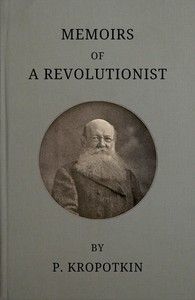
Memoirs of a revolutionist — Text and Context can be approached with a clearer sense of reading commitment from its source measurements: 168,754 words, 12 hr 14 min estimated reading time, and 21 detected text sections.
The text analysis averages about 24.6 words per sentence, while the detected sections provide another way to judge how the source is divided.
Project Gutenberg metadata also associates the work with “Russia -- Politics and government -- 1801-1917,” connecting these edition facts with the source record’s subject description.
Explore this collection
These alternatives are selected using recorded categories and estimated reading time.
About 706 minutes
Government
162,226 recorded words. 28 minutes difference from this book's estimate.
View Gutenberg source #44646About 764 minutes
Government
175,548 recorded words. 30 minutes difference from this book's estimate.
View Gutenberg source #41373About 673 minutes
Government
154,593 recorded words. 61 minutes difference from this book's estimate.
View Gutenberg source #48076Search stored excerpts and compare books → Choose by your preferences →
Choices use stored catalog measurements. Estimates vary with reading speed. A shared category is a catalog label, not a claim that two books have the same argument or literary quality.
Search reads excerpt text stored with this catalog and links to its associated Gutenberg record. The connection is stored in the site database; this tool does not recheck that every excerpt is word-for-word identical to that external record. Excerpt search does not cover every chapter and does not verify historical publication dates.
Catalog snapshot checked: 2026-09-26. Coverage: 99 public books, 99 available source excerpts.
Calculated from edition completeness, EPUB availability, text structure and catalogue metadata. Not a user rating.
Total of 100 points, scaled to a 2.5-5.0 range. Editions with an empty description or a missing EPUB file are not scored.
Public-domain source text
The source text is kept in the dedicated reader, separate from this catalogue record and its commentary.
Kropotkin opens his memoir not with his birth but with a confession of reluctance, noting that the book was written only after the persistent invitation of an editor. This framing immediately establishes a tension between private reticence and public duty that runs through the entire work. The narrative is organized into six parts, each marking a distinct geographical and psychological stage: from the enclosed world of a Moscow noble household, through the rigid hierarchy of the Corps of Pages, to the vast landscapes of Siberia, and finally into the prisons and exile communities of Western Europe. Movement between these settings is never merely travel; it is always a passage between forms of constraint and liberty, observation and action.
The memoir repeatedly returns to spaces of enclosure, from the nursery in the Moscow house to the cells of the Peter and Paul Fortress. Kropotkin describes his childhood home as a place where “the life of the children was kept quite apart from that of the grown-ups”, a separation that mirrors the larger divisions of Russian society. Later, the Corps of Pages becomes a miniature autocracy, with its own codes of honor and humiliation. In Siberia, the physical vastness of the landscape contrasts with the bureaucratic cages of exile administration. Each setting is rendered with precise architectural detail—the layout of rooms, the thickness of walls, the placement of guards—so that space itself becomes an actor in the story. The fortress where Kropotkin is imprisoned is described not as a symbol but as a structure with measurable dimensions, a place where the body is held and the mind must find its own exits.
Throughout the excerpts, images of escape and pursuit recur with notable frequency. Kropotkin’s own escape from the military hospital is a set piece of careful planning and physical exertion, but the motif appears earlier: in the “double life” of Tsar Alexander II, who signed reactionary decrees while privately despondent; in the grand duke whose orgies were so notorious that the police had to intervene; in the peasants who sought redress and were instead “imprisoned, subjected to wholesale flogging, and shot down”. The act of fleeing is never merely physical. Kropotkin traces how the state itself flees from accountability, how officials “made the Tsar believe he was poor” while amassing fortunes. The memoir’s structure mirrors this pattern: each section ends with a departure—from Russia, from prison, from one political phase to another—suggesting that revolution itself is a form of perpetual motion.
Kropotkin’s account of corruption is remarkably concrete, built not on general accusation but on documented percentages and named ministries. He reports that a friend hoping to start an enterprise was told he would have to pay “twenty-five per cent. of the net profits to a certain person, fifteen per cent. to one man at the Ministry of Finances, ten per cent. to another man in the same ministry, and five per cent. to a fourth person.” The specificity of these figures gives the indictment a forensic quality. Corruption is not an abstract evil but a system with its own tariff. Kropotkin notes that Alexander II knew of the thefts but “saw in the thieves his protectors from the revolution”, a chilling equation of graft with political survival. The memoir thus presents the state as a machine that consumes its own resources, with the court, the ministries, and the police forming a closed circuit of mutual protection. The reader is left to observe how this system generates the very opposition it fears.
The narrative moves constantly between the intimate and the institutional. A single paragraph may begin with the Tsar’s private remarks on a report and end with the flogging of peasants in a distant province. This rapid alternation of scale is a deliberate structural choice. Kropotkin shows how decisions made in the palace ripple outward to the Bashkir lands of Orenburg and the confiscated estates of Lithuania. Conversely, local scandals—like the “most revolting stories” of peasant dispossession—eventually reach the Senate and the Tsar’s ears. The memoir’s geography is not neutral; it is a map of power. Siberia is not just a place of exile but a laboratory where the state’s methods are tested. Western Europe is not merely a refuge but a vantage point from which to see Russia whole. By moving between these settings, Kropotkin constructs a political geography in which every location is defined by its relation to authority.
Readers approaching this memoir should attend to its silences as well as its statements. Kropotkin often withholds judgment, letting the arrangement of scenes and the accumulation of detail do the work of argument. The book is not a confession or a manifesto but a record of how one man came to see the world as a system of interlocking constraints—and how he learned to move within them. The structure itself, with its six parts and its repeated returns to the theme of escape, offers a model of political education that is also a kind of cartography.
I kept thinking about how Kropotkin’s cage shifted from gilded to iron, each door just a different shape of the same lock. That quiet, creeping recognition of systemic rot stayed with me. Then I found Origin of the Anglo-Boer War Revealed: The Conspiracy of the 19th Century Unmasked (2nd ed.) — Key Ideas to Explore, and the same shadow fell—not loudly, just a slow certainty that the official story was never the whole one.
Save your reaction, strongest insight, and memorable passage.









